
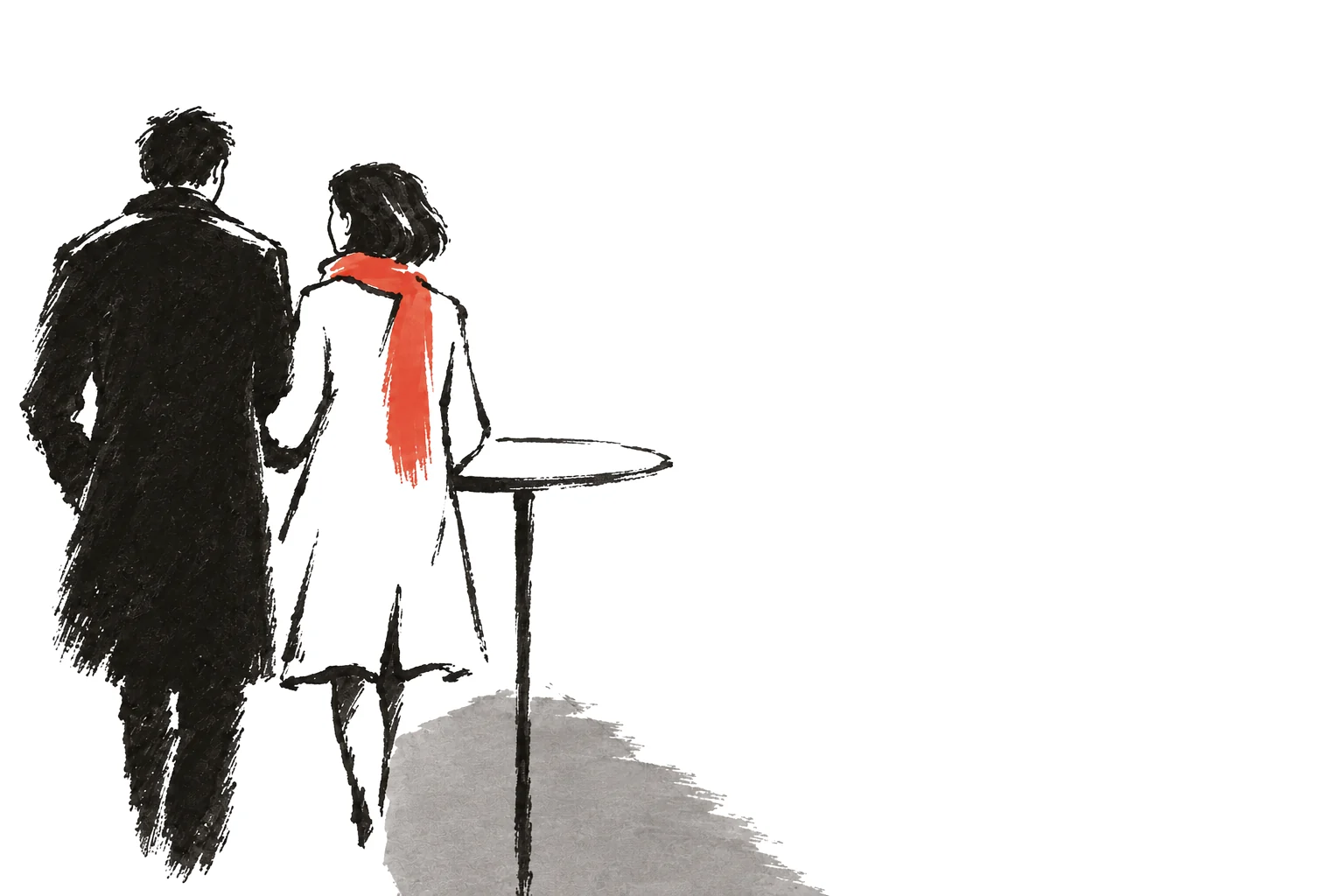
Expect no sign on the door. You may see a street number or a small logo, and a doorman like the one at any good bar. Clubs keep the outside plain to protect their members' privacy, so you may doubt for a moment that you have the right address, even though you do.
What the Crowd Looks Like
Many first-timers expect the club to look like the videos, and it does not. When people describe their first visit, the most common thing they say is that it was just real people: couples who look like your neighbors or coworkers, having a drink and a laugh in a nice room. Seeing that is a relief, because the fantasy in your head is usually what makes you nervous.
Before You Go: One Conversation You Must Have
Settle two things with your partner before you leave the house, not in the parking lot or over the first drink.
1. What each of you wants tonight. If one of you hopes the night ends a certain way and the other expects only to look, you arrive with a misunderstanding. The most common problem on a first night comes from inside the couple: one partner quietly pushes and the other goes along without saying so. Talk about the gap now, before it turns into resentment.
2. An exit signal. Agree on a hand squeeze, a code word or a look that means you want to leave, so neither of you has to say it across a crowded room. Using it does not mean the night failed. Knowing that the other will leave without an argument is what lets you both relax.
The most common problem on a first night comes from inside the couple: one partner quietly pushes and the other goes along without saying so.
Getting In
Most clubs require membership: an online profile, sometimes a screening step, and often an annual fee on top of the cover charge. Sort this out before you go, or you can drive an hour and be turned away at the door. The cover charge on the night is typically about the price of a good dinner out.
At the door, expect three steps: ID, a membership check and payment. Then tell the staff it's your first time. Well-run clubs have a routine for first-timers: someone shows you around, points out the rules and answers what you may be too nervous to ask. Staff see it as a sign that you respect the place.
Dress code
People underestimate the dress code. It is enforced, and not knowing about it will still get you turned away. The baseline is cocktail attire, meaning clothes that show effort. If in doubt, overdress.
| Reads as effort | Gets you turned away |
|---|---|
| Dress pants, collared shirt, jacket | Jeans, hoodies, athletic wear |
| A dress or a smart top | Sneakers, flip-flops, ball caps |
| Clean, fitted clothes for going somewhere nice | Clothes you would wear around the house |
Timing: Get There Early
Arrive around when the doors open, before the busiest hours. A half-empty room may sound more awkward, but it is easier on a first visit:
- You watch the room fill up instead of walking in at midnight to a full room where people already know each other.
- You find the bar, the bathrooms and the layout while it is calm.
- The staff have time to show you around.
What the Space Looks Like
A possible layout, from the door:
- the entrance and a coat check
- the social area: bar, lounge, sometimes a dance floor
- a hallway or curtained doorway
- the play areas
You will spend most of your first night in the social area, perhaps all of it, and that is fine. Early in the evening people talk about the weather, their jobs and where they parked.
The play areas are clearly marked off, so you will not wander in by accident. Most clubs have open shared areas and private rooms, and the door tells you which is which:
- Closed door: private. Leave it alone.
- Open door: the meaning varies by club. If you are not sure, ask the staff.
The house rules (no phones in the play areas, ask before touching) are posted at the entrance. Read them, because they apply to you.
Phones and Photography
Phones are banned in the play areas. Photographing or filming anyone without explicit consent is forbidden everywhere in the building, and the penalty is immediate removal and a permanent ban. In one story told as a warning, a couple took photos in the locker room on arrival and were walked out before they reached the dance floor. Members have careers and families, and one photo can end something that matters to them, so clubs give nobody the benefit of the doubt. Take any photo of the two of you in the car, then put the phone away for the night.
Consent and Approaches
All physical contact needs permission, regardless of the atmosphere or what anyone is wearing. The answer is no until someone clearly says yes.
The community is small and people talk, so others will remember how you take a no.
Approaches usually follow this etiquette:
| Who | How it usually works |
|---|---|
| Couples | Approach other couples, the usual opening. |
| Women | Welcome to initiate anything. |
| Single men | Wait to be approached, or for an unambiguous signal. |
A no in any form ends the approach: flat, polite, vague or only someone turning away. Do not argue, ask if they are sure, or try again an hour later. The community is small and people talk, so others will remember how you take a no.
Single Male Norms
Many clubs admit only a small number of single men per night, and the etiquette for them is strict. The full list:
- Be social before anything else.
- Accept every no at once and completely.
- Don't hover near couples.
- Don't approach without a clear signal.
As a single man you compete with many other single men, and your reputation for keeping these rules decides whether you become a regular or get quietly walked to the door.
The Two Most Common Mistakes
Experienced couples name these two again and again.
1. Drinking for courage. If you need three drinks to feel comfortable there, you are not ready to be there yet, and alcohol will not change that. You stay nervous, with worse judgment and worse instincts about consent. A drink to relax is fine. If you need to drink to get through the door, go home, talk it over and come back another time.
2. Expecting too much too soon. The scene moves slowly and rewards patience. Couples who treat the first visits like getting to know a new bar full of interesting people last longer than couples who expect the first night to deliver something.
Nothing has to happen on a first visit: a drink and a good conversation make a complete one.
How to End the Night
You can leave whenever you want, and you owe nobody a reason or a long goodbye. Saying "thanks, we're heading out" to whoever greeted you is enough. If something felt wrong, leave first and talk about it afterwards, outside the club.
Then talk about the night on the drive home. Each of you answers three questions:
- What surprised you?
- What felt good?
- What felt wrong, and was it a real problem or only nerves?
Have this conversation honestly after every visit. Over several visits, your answers tell you whether the lifestyle suits you.
FAQs
What if we get there and immediately want to leave?
Then leave. Saying "thanks, we're heading out" to whoever greeted you is enough. A decent club will not make you feel you owe it a full evening, and leaving early is a normal end to a first visit. Sometimes the first night is only about finding out that you can walk in.
Will we get pressured into anything?
Not at a well-run club. If anyone does pressure you, tell the staff, who deal with it quickly and quietly. The pressure most newcomers feel comes from their own heads: the sense that they should do more than they want to. There is no quota, and a drink and a conversation is a full first visit.
We're nervous. Is that normal?
Yes. People with years in the lifestyle usually describe their first time as exciting and frightening in equal measure, and say that by the second or third visit the room looked like any other room. On the first visit your nerves make the place seem stranger than it is, so go in anyway.